
Finger Millet Benefits: Why Mandua and Jhangora Are Ancient Superfoods You Need
March 19, 2026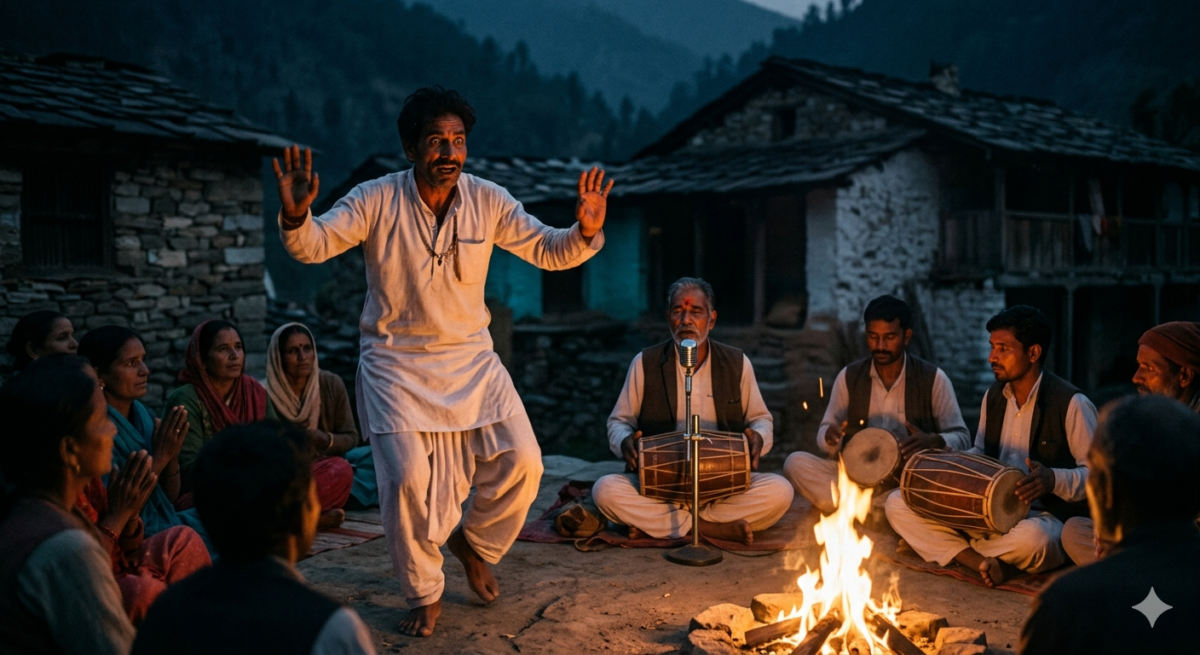
Introduction
Jagar Uttarakhand continues to fascinate communities across the Himalayas, even as ancient texts like the Sam Veda mentioned this ritual practice between 1500 to 1000 BCE. This nocturnal shamanic ceremony has co-existed with mainstream Hinduism for ages and provides spiritual healing and divine connection through trance states. The jagar meaning stems from the Sanskrit root “Jaga,” which signifies “to wake”. Practiced throughout Garhwal and Kumaon, jagar in Uttarakhand culture shows through three main forms: Dev Jagar and Bhoot Jagar, along with Masan Puja. We’ll explore why this powerful ritual remains relevant in 2026.
What is Jagar: Understanding Uttarakhand’s Sacred Night Ritual
Jagar meaning and origin from Sanskrit
The ritual’s name reveals its fundamental purpose. Jagar originates from the Sanskrit root “Jaga,” which translates to “to wake”. This etymology carries deeper linguistic connections. Scholars trace the term through related Sanskrit words including Jagran (wakefulness), Jagrit (awakened), and Ujagar (revealed). The terminology reflects a pure Vedic lineage and positions jagar meaning within ancient spiritual frameworks that predate modern religious categorizations.
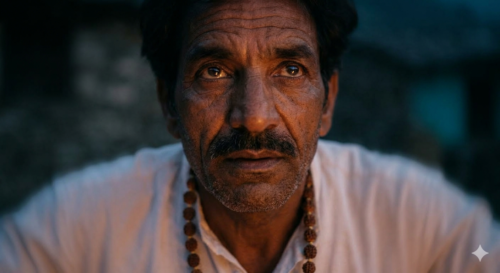
The awakening in jagar in Uttarakhand culture extends beyond simple wakefulness. Jagran refers to a night vigil during worship, but jagar covers something more profound. The ritual involves awakening the subtle bodies of deities through the gross body of a medium, called the Pashwa or Dagariya. This physical demonstration creates a tangible bridge between the realms and allows villagers to meet their deities in bodily form. Communities seek to express devotion and receive blessings through this direct encounter, and the attachment runs deep.
The three main types: Dev Jagar, Bhoot Jagar, and Masaan Jagar
Scholars categorize jagar uttarakhand ceremonies into three distinct forms based on their themes and singing styles. Each serves different spiritual purposes and invokes different entities.
Dev Jagar represents the most common form. Benevolent deities demonstrate themselves through a human medium. Local gods occupy the medium’s body to bestow blessings and rewards upon attending devotees. Communities perform Dev Jagar to seek intervention for problems or receive protection from their Kul Devta (family deity). The gods awakened during these sessions include local deities like Bhumiya, Kshetrapala, Golu Devta, Nanda Devi, and Kartikeya.
Bhoot Jagar focuses on summoning spirits of deceased persons. The term “Bhoot” in Hindi refers to a spirit or ghost. This ritual allows the departed soul to inhabit a human body for a short time. The spirit addresses the grievances of petitioners and provides closure or resolution to unfinished matters. Sometimes these summoned spirits become unruly and require specific pacification techniques to restore order.
The third category, Masaan Jagar, involves invoking malevolent spirits. These rituals carry a different tone and are often performed with mockery or ridicule directed at the troublesome entities. Masaan Puja represents one of the less practiced forms within jagar uttarakhand traditions.
How Jagar is different from other Hindu rituals
Jagar stands apart from mainstream Hindu practices through its connection to justice and physical demonstration. The ritual serves as a mechanism to seek penance for crimes or demand justice from gods for injustices noticed. This judicial aspect creates a spiritual court where humans can confess wrongdoings or petition for righteous intervention.
The Himalayan isolation of Kumaon and Garhwal regions promoted the emergence of these local religious traditions. Most ancient deities disappeared or merged into monotheistic practices, but Hinduism’s strong kuladevata traditions enabled jagar to flourish among mainstream worship. The ritual functions as a living folklore and preserves local heritage while reflecting the deep-rooted faith in supernatural powers. Life’s hardships in mountainous terrain promoted this practice. Communities sought meaningful ways to connect with ancestors and explore guidance.
The Key People Who Bring Jagar to Life
Every jagar uttarakhand ceremony requires specific individuals who carry hereditary knowledge and spiritual authority. These practitioners transform ordinary village courtyards into sacred spaces where gods walk among mortals.
Jagariya: The master singer who invokes the gods
The Jagariya serves as the main priest-singer who leads the ritual through ballads and invocations. This master narrator comes from the Shilpkar community, a hereditary group with lower status in history. The Jagariya narrates and sings ballads of gods or departed spirits with indigenous musical instruments and draws allusions to Indian epics like the Mahabharata and Ramayana.
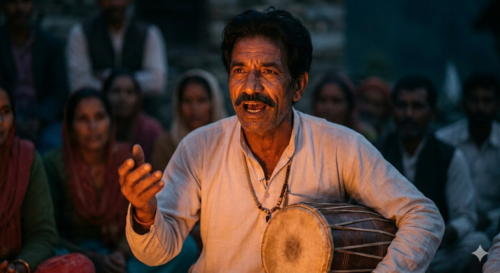
The Jagariya’s voice carries ballads of gods, warriors, and forgotten heroes into the night. This singer performs with a small team of two or three members who join in chorus and play drums to support the ceremony. The Jagariya possesses the dignity of a Guru or priest in villages across the central Himalayas. The role just needs deep knowledge of regional folklore, myths and legends, plus exceptional vocal stamina to sustain performances that extend over multiple nights.
Dangariya: The human medium for divine possession
The Dangariya acts as the vessel through whom deities physically show themselves during jagar in uttarakhand culture. The term derives from the Kumaoni word “Dangar,” meaning way, as the Dangariya shows the path for gods to enter the earthly realm.
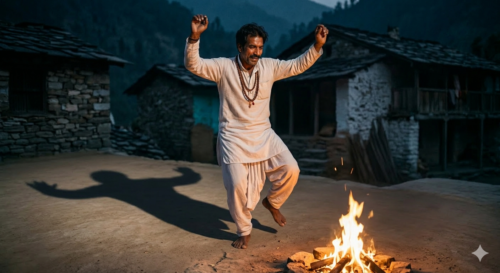
The Dangariya’s body trembles and voice deepens as chants intensify and drumbeats reach a frenzied tempo. This medium becomes someone else. The possessed shaman reveals long-buried family secrets, shows hidden injustices, and heals the ailing. Once possessed by deities like Golu Devta, the Dangariya exhibits deity-like behaviors that include altered voice, convulsive movements and ecstatic dancing. The Dangariya collapses after the spirits return to their ethereal abodes, exhausted from the divine weight.
Syonkar: The host seeking divine intervention
The Syonkar organizes the Jagar to seek divine intervention for personal problems. This sponsor bears the financial burden of the event and procures offerings like rice grains, floral arrangements, and animal sacrifices as directed by invoked deities. The ritual occurs at the Syonkar’s home, where they prepare the venue through complete cleansing and kindle the sacred fire known as dhuni.
Hurkiyas and Bajgis: The drummers and healers
The Hurkiyas play the hourglass-shaped pressure drum called the hurka and act as healers during possession rituals. The Bajgis perform on the dhol damau, two of the most important instruments used during Uttarakhand rituals. Drumming and narrations during the puja ceremony awaken the deities and improve the emotional and spiritual well-being of attendees. The Hurkiya keeps rhythm and strikes the small drum to create the sonic environment essential for spirit invocation.
How a Jagar Ceremony Unfolds from Start to Finish
Witnessing a jagar ceremony unfold requires patience. These rituals can last anywhere from one to twenty-two days. The length depends on the complexity of community needs being addressed.
Preparing the sacred space and lighting the Dhuni
Purification begins before any chants echo through the night. The Jagariya oversees cleansing processes administered with sacred items to sanctify the venue and dispel impurities. The Syonkar sprinkles gomutra (cow urine) in all directions twice and establishes a spiritual boundary for divine invocation. This practice cleanses the space and creates protection against unwanted entities.
After purification, the sacred fire becomes the focal point. The Jagariya lights the Dhuni, also known as Sagarh, for Homa offerings. This fire symbolizes divine presence and must burn steadily throughout the ceremony. The Jagariya arranges essential materials beforehand: uncooked grains, handmade flower garlands, ghee and rice. Regional variations exist between Garhwal and Kumaon in these offerings.
Sanjhwali Geet: Remembering all the gods
Oil lamps flicker in dim light. The invocation phase commences with Sanjhwali Geet. These evening songs invoke assistance from all 33 koti (crores) of Hindu gods, reciting their names and seeking blessings for successful completion. The vernacular compositions honor the broader pantheon before focusing on the primary deity. This collective remembrance promotes communal unity and prepares participants spiritually for what follows.
Birtwai: Singing ballads of the deity
After the general invocations, the focus narrows to the target deity. The divine spirit being called upon receives praises through biographical ballads during Birtwai. These narrations recount the deity’s adventures, exploits and heroic deeds, whether Goludev, Narsingh, or another local guardian. The ballads personalize the invocation and draw from myths in epics like the Mahabharata, performed with rhythmic vocal inflections. The recounting builds reverence and draws the deity nearer to the earthly plane.
Ausan: Building to the trance state
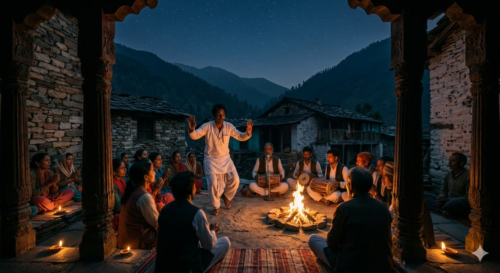
The sonic environment shifts dramatically during Ausan. The volume of traditional instruments like the Hurka, dhol and damau intensifies. This musical buildup creates an immersive atmosphere that amplifies the invocatory intent. The Dangariya’s movements become frenetic as drumbeats accelerate. Eyes roll back, body convulses, and the boundary between worlds thins.
The possession and divine dialog
The deity manifests fully when trance overtakes the medium. The first act involves Guru Aarti, a tribute to Guru Gorakhnath, revered as the preceptor of all local deities. This protective ritual ensures safe channeling of divine energy during possession. The deity then addresses grievances, dispenses justice and provides guidance on community issues. Divine voices speak truths no human tongue could carry alone through the trembling form.
The Khakh Raman ritual follows and applies vibhuti (sacred ash from the homa fire) to foreheads of the possessed medium, afflicted individuals and assembled participants. This ash serves as a tangible mark of divine presence and purification.
Closing rituals: Khakh Raman to Prasthan
The Prasthan phase begins as dawn approaches. The Jagariya sings specialized songs that signal the deities’ return to their heavenly abodes. The medium performs a concluding dance while the ritual initiator repeats a short deity-specific song. The trance releases, trembling ceases, and the Dangariya collapses back into ordinary consciousness. Drumbeats slow as embers cool.
The Deep Psychology Behind Why Jagar Still Works
Why jagar uttarakhand maintains its grip on communities becomes clear when we look at the psychological mechanisms at work beneath the drumbeats and possession states.
Emotional release and healing through collective ritual
Jagar functions as a therapeutic outlet for communities dealing with trauma, stress, or social conflict. The ritual provides a safe space to express deep emotions, whether positive or negative, through a process analogous to catharsis. A performer singing a jagar invokes deep personal or collective feelings, often in response to personal loss or community-wide celebrations. This emotional expression allows people to purge emotions like anger or sorrow and leads to relief and emotional balance.
The communal nature of these rituals promotes social cohesion. It provides a supportive environment if you have illness and reduces feelings of isolation and helplessness. Shared grief rituals allow people to process loss within their social networks and strengthen social bonds. The dramatic elements, including deity invocations through mediums, evoke awe and fear. They appeal to primal aspects of human psychology. The community seeks restoration of harmony between human and divine realms through this ritual.
How trance states connect conscious and subconscious minds
The repetitive drumming, chanting, and presence of mediums in trance states induce altered states of consciousness. These states allow participants to feel connected with the divine and break barriers between the conscious and subconscious mind. Jagar creates a neutral, liminal space where the living, departed souls, and divine entities interact without hierarchy. This promotes catharsis and restoration.
Sound stands out as one of the most ancient means to induce altered states of consciousness. The shamanic journey undertaken during possession involves powerful experiences often described as lucid dreams.
Jagar as a response to life’s uncertainties
Life feels uncertain or unpredictable, so people turn to jagar to strengthen belief in divine protection. The ritual gives people hope and a feeling that they have some control over their lives. These rituals provide a sense of comfort and control over illness and ease fear and anxiety. Belief in divine intervention connects people to their cultural heritage and strengthens them through the belief that spiritual forces influence their health.
The role of music and drums in altering consciousness
Rhythmic auditory input modulates conscious states through neural mechanisms. The observation that repetitive auditory stimulation alone can modulate consciousness suggests a mechanism that exerts broad influence on the cerebral cortex. One potential mechanism is thalamic gating, where the thalamus can either propagate unfiltered sensory information to the cortex or block it. Thalamocortical coupling facilitates an inward-directed state by isolating the cortex from external stimuli.
Why Jagar Remains Powerful in Modern Uttarakhand
Migration patterns have altered how jagar survives in Uttarakhand culture. The perception of jagar has changed from being regarded as a crass practice to one that gains recognition for its cultural and historical significance.
Urban migration and Jagar’s adaptation to cities like Delhi
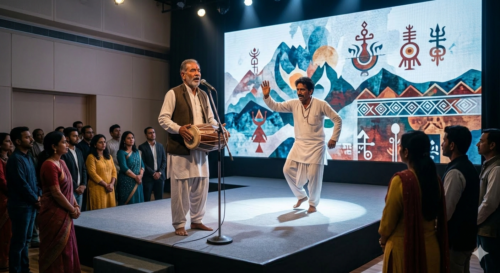
Many Kumauni and Garhwali people live in Delhi and cannot return to villages each year for jagar. They have initiated the ritual in Delhi. Stage performances now employ raised platforms, microphones, speakers and projection screens. People move away from their homeland and carry indigenous knowledge with them. They attempt to re-enact traditions in new locations. The city-based jagar programs present ritual music on a public platform and retain the religious fabric.
From ritual to cultural identity marker
The ritual reinforces shared belief systems and creates a psychological sense of unity and belonging. Jagar functions as a way of spiritual expression that reinforces cultural values and shared identity. These enactments help community members stay connected to their heritage and preserve their sense of identity.
Notable performers keeping the tradition alive
Preetam Bhartwan belongs to a hereditary musician family. He is often addressed with the title “jagar samraat” and has popularized jagar especially among diasporic communities. Basanti Bisht broke barriers as the first woman to sing jagar and received the Padma Shri in 2017.
Jagar’s role in mental health and community healing in 2026
Villagers report relief from mental, physical and emotional problems after jagar ceremonies. Basanti Bisht witnessed people with mental disorders get cured by listening to jagar.
Key Takeaways
Jagar is an ancient Himalayan ritual that continues to provide spiritual healing and community connection in modern times, adapting from village ceremonies to urban performances while maintaining its transformative power.
- Jagar involves three distinct forms: Dev Jagar (benevolent deities), Bhoot Jagar (deceased spirits), and Masaan Jagar (malevolent entities), each serving different spiritual purposes.
- The ritual creates therapeutic emotional release through collective participation, using trance states and rhythmic drumming to connect conscious and subconscious minds.
- Urban migration has transformed Jagar from village courtyards to city stages, with diaspora communities in Delhi preserving traditions through modern adaptations.
- Scientific research validates Jagar’s psychological benefits, showing how repetitive auditory stimulation and communal rituals provide mental health support and cultural identity reinforcement.
- Notable performers like Padma Shri recipient Basanti Bisht demonstrate how traditional practices evolve while maintaining authenticity, ensuring cultural preservation across generations.
The enduring appeal of Jagar lies in its ability to address fundamental human needs for community, healing, and spiritual connection—needs that remain constant regardless of technological advancement or geographical displacement.
Conclusion
Jagar Uttarakhand proves that ancient rituals can thrive among modern life. The ceremony’s power lies not just in theatrical possession states but in knowing how to provide emotional healing and preserve cultural identity across generations.
The ritual has adapted to urban settings without losing its spiritual core. Performers like Preetam Bhartwan and Basanti Bisht demonstrate how tradition evolves while maintaining authenticity.
The experience remains transformative whether you witness jagar in a mountain village or a Delhi auditorium. The drumbeats still awaken something deep within participants. Some connections between humans and the divine exceed time and geography, and this proves it.